





Owners ask what advertising on Google cost looks like and want a single number. There is not one. A click on "emergency plumber" and a click on "how to unclog a drain" are different products. What you can plan is a monthly budget, a cost per booked job, and whether the account is wasting money on the wrong searches.
For how CPC and Quality Score work inside the auction, read Google paid search cost. This page is the budget conversation: how much to fund, what you get, and how to know if it is working.
A usable starting budget
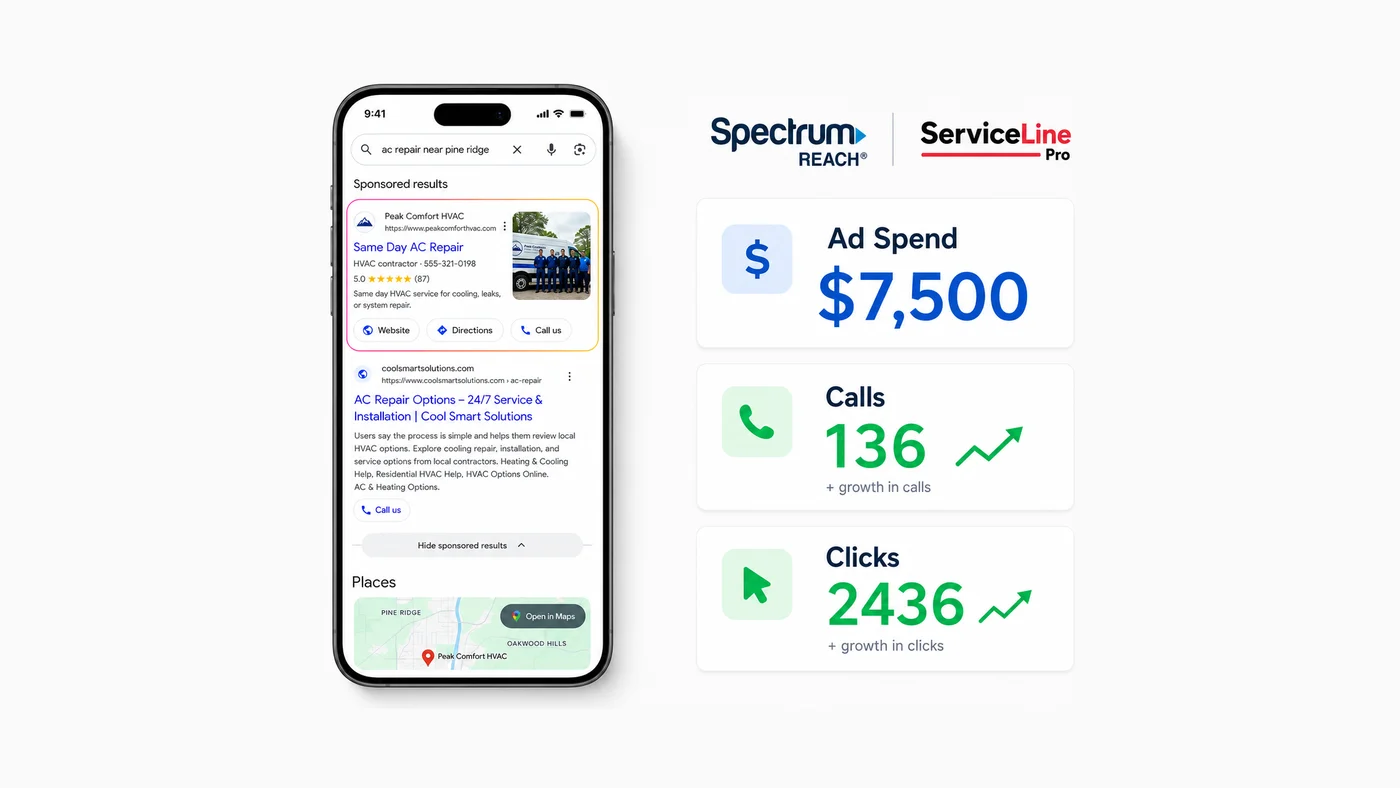
In a competitive metro, plan on around $5,000 a month in Google Ads spend for one trade. That is typical, not a law. Smaller towns can run on less. Roofing, kitchen/bath, and HVAC in dense suburbs often need that level to stay in auctions all day without the ads dying at 2 p.m.
ServiceLine Pro charges $0 agency fee on Google Ads. The Spectrum Reach partnership pays us. Your $5,000 buys media, not a 15% markup. Leads often show inside 7 days once the landing pages and call tracking are live.
"A higher CPC is survivable when the job is profitable. An untracked account is not."
CPC vs cost per lead vs cost per job
- ·CPC is the toll for a visit. Useful for spotting waste. Useless as the scoreboard.
- ·Cost per lead is spend divided by calls and forms. Still includes junk.
- ·Cost per booked job is spend divided by jobs that landed on the schedule. That is the number that pays trucks.
High-intent keywords cost more per click because the job behind them is larger. That can still be cheap per job. A $40 click that becomes an $18,000 kitchen is a different story than a $8 click that becomes a $90 unclog you lose money on after drive time.
Four levers on the monthly bill
1. What you bid on
Bid on the jobs you want. "Emergency roof replacement," "tankless water heater install," "pool leak detection." Pause or negate DIY, careers, wholesale, and cities outside the dispatch map. The search terms report is a weekly meeting, not a quarterly surprise.
2. Where the ads show
Radius or zips you actually serve. Presence, not "interest." A tourist reading about Kansas City kitchens from a hotel in Dallas should not spend your budget. Exclude the office park if you keep clicking your own ads.
3. When ads run
If nobody answers after 6 p.m., do not buy 6 p.m. clicks unless a trained after-hours service picks up. You already paid Google for the lead you dumped to voicemail.
4. The page they hit
Match the keyword, load in under two seconds, put the phone first. Quality Score rewards that. It is one of the few ways to pay less than a sloppier competitor for the same search. See how to drive traffic to the website.
"A higher CPC is survivable when the job is profitable. An untracked account is not."
How Google cost compares to other paid options
- ·Local Services Ads: pay per lead Google sends. Less keyword control. Strong when you can answer fast and keep reviews high.
- ·Pay Per Qualified Lead: $1,000 deposit credited. Pay only for qualified calls (decision maker, business hours, real interest, contact captured).
- ·ChatGPT Ads: $1,500 setup plus $500 a month. A sold product, not a rumor.
- ·OTT/CTV: branding, typically $5,000 a month and up. Nobody calls from the commercial. Do not use it as a substitute for search.
SEO at $3,000 a month is not an ad invoice. It is the attempt to own the Map Pack so you buy fewer clicks over time. 90-day Top-3 is a target. If we miss it, we keep working. We do not guarantee rankings.
Can I start at $1,000 a month in Google Ads?
You can. In a competitive metro the ads often exhaust before lunch, and Google never gathers enough conversion data to bid well. Treat $1,000 as a short test on one service line, not a full-market plan. Around $5,000 a month is the more realistic metro budget if you want coverage and learning speed.
Put this into practice
Google Ads at $0 agency fee, typical metro spend around $5,000 a month, leads often inside 7 days. The $1,000 Growth Audit shows what your current cost per booked job really is. Book a strategy call at (813) 669-7572.
Get a real diagnosis of your business.
A seven-layer review of your SEO, Google Ads, website, and Map Pack presence, delivered as a written report within 72 hours. It's $1,000 and it always credits toward any work you do with us. If we don't find $100,000 in missed revenue, we refund it.
Get the Growth Audit