





Your phone rings all day. Some calls turn into booked jobs. Some are price shoppers. Some are existing customers. Some should never have reached your dispatcher. Meanwhile you are paying for Google Ads, trying to rank in the Map Pack, maybe running mailers and wrapped trucks. The problem is knowing which marketing is driving the right calls.
Most contractors can say what they spent and how many calls came in. They cannot say which channel produced the calls that turned into revenue. So budgets get set by gut. Good campaigns get underfunded. Weak campaigns stay alive too long. Dispatch gets blamed for lead quality. Marketing gets blamed for slow weeks. Call tracking marketing fixes that. It connects the call to the source, the source to the campaign, and the campaign to the booked job.
Stop guessing where the best leads come from
You launch Google Ads for drain cleaning. Your SEO partner says the Google Business Profile is improving. Yard signs are out. Vans are wrapped. Calls increase. Someone asks where the best calls came from. If the answer is "probably Google" or "the office asks how they heard about us," you are still guessing.
Phone-first leads still punch above their weight in the trades. People with no AC, a leaking pipe, or a failed panel want a person, not a nurture sequence. Attribution still breaks: customers remember the last touch, office staff skip the "how did you hear" field, and branded searches hide the ad that created the name in the first place.
"If you do not track calls back to campaigns, every budget discussion turns into opinion."
"If you do not track calls back to campaigns, every budget discussion turns into opinion."
How call tracking works
Think of it like a different coupon code on each ad, except the customer does not read the code back. A postcard gets one number. Google Ads gets another. Organic search can trigger another through the website. Each number still rings your main line. The software records which source caused the call.
- 01 Assign tracking numbers to sources: Google Ads, local SEO/organic, Google Business Profile, LSAs, direct mail, PPQL.
- 02 The customer sees that number. On the website, dynamic number insertion (DNI) swaps the visible number based on how they arrived.
- 03 The call forwards to the regular line. The team answers like normal.
- 04 The software logs source, duration, recording, and (if you set it up) a quality grade.
- 05 You review what produced qualified calls and move budget, scripts, and staffing.
What to grade, not just count
A 15-second hang-up is not a lead. For Pay Per Qualified Lead and for honest PPC, a qualified call is a decision maker, during business hours, with real interest, and a captured contact. Score calls weekly. Import only qualified conversions into Google Ads so Smart Bidding chases booked work, not junk volume.
- ·Keep one pool of numbers per channel so reports stay readable. Do not spawn a new number for every keyword unless you have a reason.
- ·Whisper the source to the CSR so they know the campaign without asking the caller.
- ·Do not put tracking numbers on citations and the Google Business Profile as the public NAP. Citations need the real local number. Use tracking on ads and the site.
- ·Match the displayed site number to DNI so you do not train Google on a mismatch.
What the first month looks like
- 01 Inventory every public number: site, GBP, trucks, invoices, ads.
- 02 Lock NAP on citations to the real local number.
- 03 Turn on DNI and per-channel numbers for ads and organic.
- 04 Train CSRs on the grade: decision maker, business hours, real interest, contact captured.
- 05 Import only qualified conversions into Google Ads after two weeks of grades.
The monthly scoreboard
Calls by source. Qualified rate. Cost per qualified call. Cost per booked job. That last number is the only one that should move budget. A cheap shared-lead call that never closes is the expensive one.
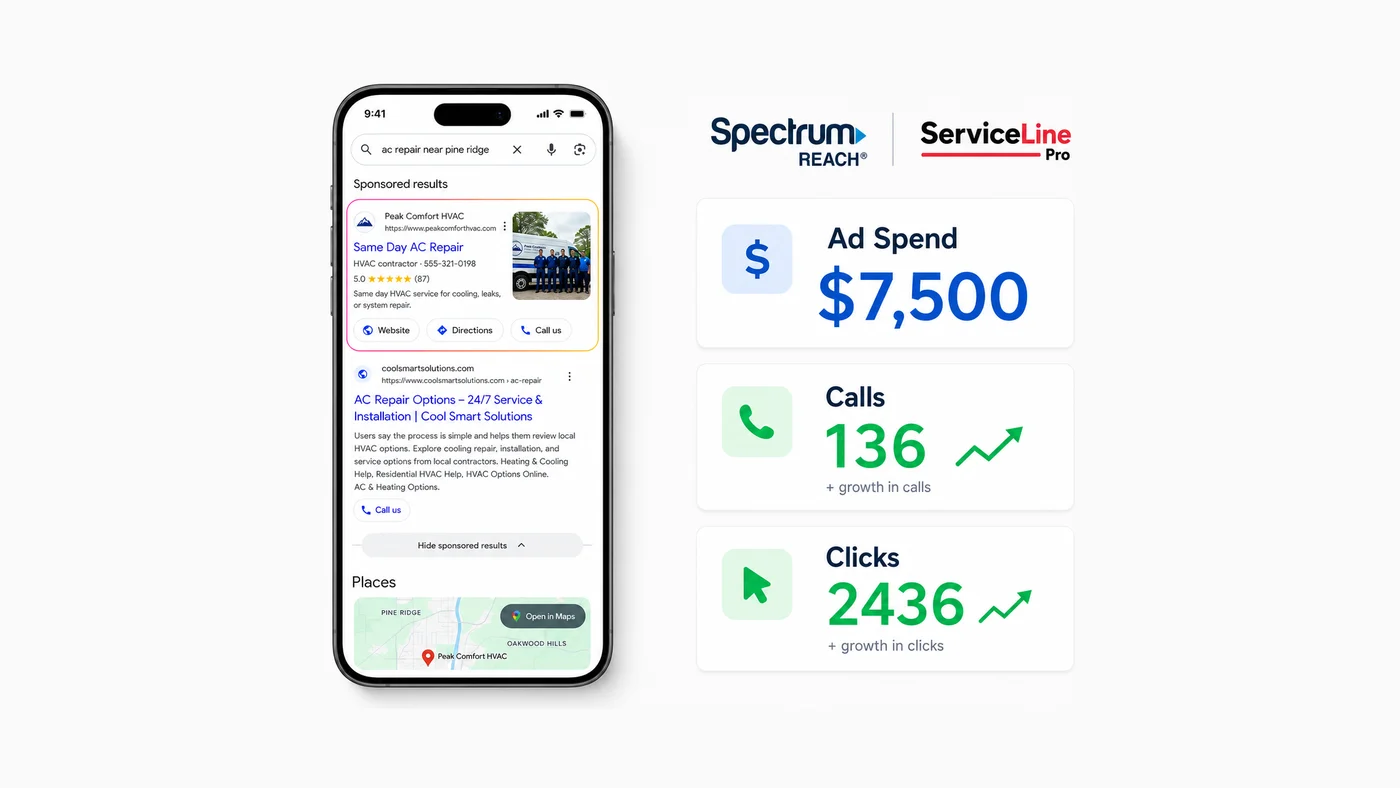
Paid search works when every dollar is tracked to a call and every call is tracked to a booked job. Our Google Ads management runs with $0 agency fee. Spectrum pays us. Typical spend around $5,000 per month in a competitive metro. Start with the $1,000 Growth Audit to see what current campaigns leave on the table. Or book a strategy call at (813) 669-7572.
Frequently Asked Questions
What is call tracking marketing?
Unique phone numbers (and website number swapping) that attribute inbound calls to a campaign or channel, with recordings and grades so you can compute cost per booked job.
Will tracking numbers hurt my local SEO?
They can if you publish them as the official NAP on citations and Google Business Profile. Keep the real local number on listings. Use tracking numbers on ads and, via DNI, on the website.
What should I do with call recordings?
Grade quality weekly. Coach CSRs. Feed qualified conversions back to Google Ads. Dispute unqualified PPQL calls using the written definition: decision maker, business hours, real interest, contact captured.
Get a real diagnosis of your business.
A seven-layer review of your SEO, Google Ads, website, and Map Pack presence, delivered as a written report within 72 hours. It's $1,000 and it always credits toward any work you do with us. If we don't find $100,000 in missed revenue, we refund it.
Get the Growth Audit